
The heat pump has established itself as the heat generator of choice in Switzerland: the vast majority of new builds are equipped with one, and renovations follow the same trend. But how does this machine manage to heat an entire house while consuming so little electricity? This guide explains how a heat pump works, step by step: the thermodynamic principle, the 4-stage refrigeration cycle, the three energy sources, the COP, and even the cooling function.
Simply explained: the principle in 30 seconds
A heat pump works like a refrigerator, only in reverse: instead of extracting heat from an interior and releasing it outside, it extracts heat from the environment (air, ground or groundwater) and releases it into the house. A refrigerant absorbs the ambient heat, an electrically driven compressor raises it to heating temperature, and a heat exchanger transfers it to the heating circuit and domestic hot water. 1 kWh of electricity thus becomes 3 to 4 kWh of heat, because most of the energy comes free from the environment.
The principle: thermodynamic heating
A heat pump is thermodynamic heating. It does not produce heat by burning a fuel: it recovers the free energy present in the environment — the air, the ground or water — and delivers it as heat inside the house.
Concretely, the heat contained in the outdoor air, the ground or groundwater is first captured by an evaporator, then injected into the heating system via a condenser. That is the whole efficiency of the system: to cover the entire heating demand, the heat pump draws most of the energy from the environment and only adds the small share of electricity the compressor needs.
The principle works even in cold weather. Air at -10 °C still contains usable thermal energy: the refrigerant circulating in the machine evaporates at far lower temperatures still, which lets it capture heat in the middle of winter.
The refrigeration cycle in 4 steps
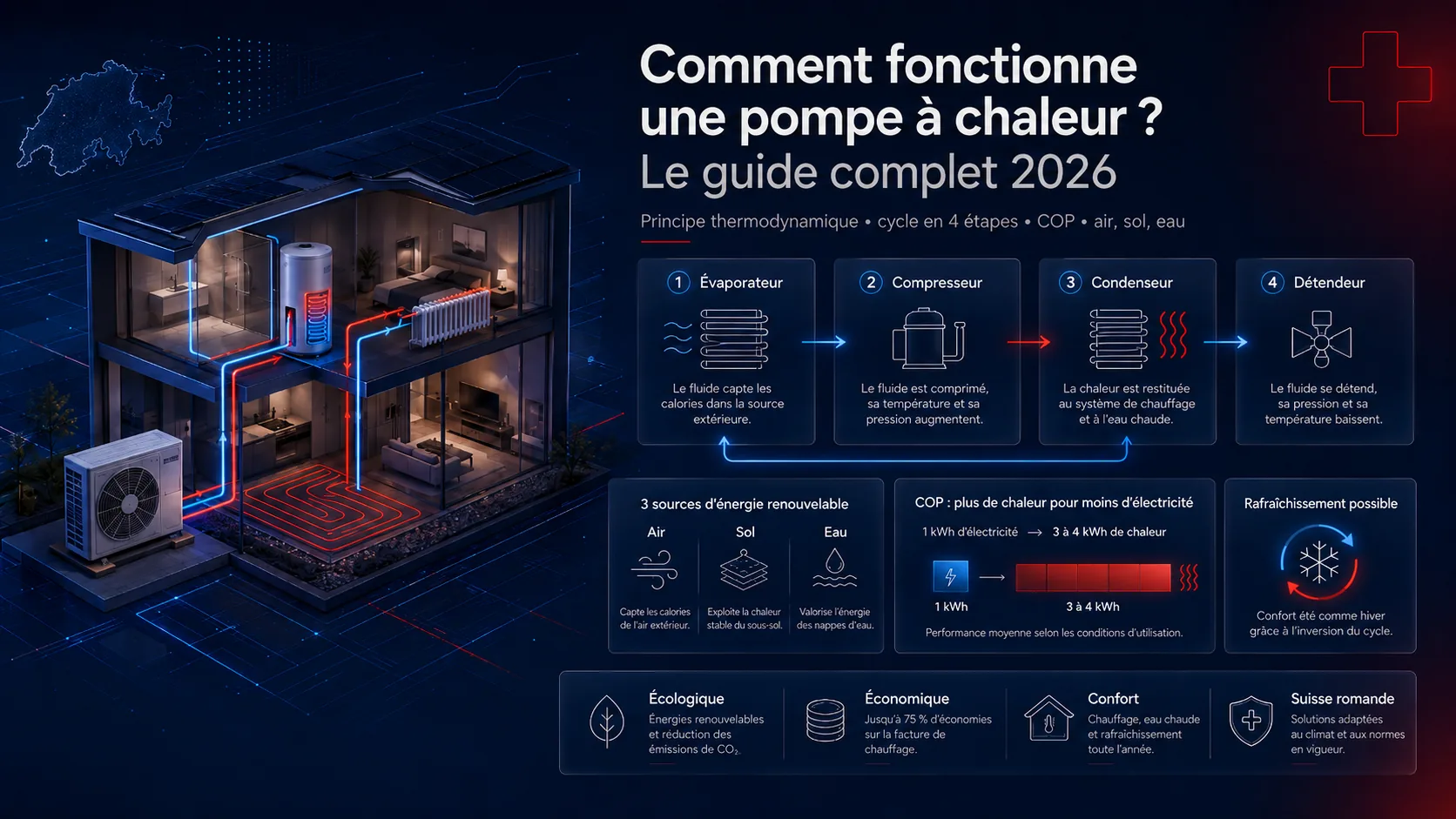
The heart of a heat pump is a closed circuit in which a refrigerant circulates. This fluid changes state in a loop — liquid, gaseous, then liquid again — as it passes through four components. This cycle is what carries the heat from outside to inside.
1. The evaporator: capturing the heat
The heat captured outside (from the air, ground or water) is absorbed by the evaporator, which contains the refrigerant in a liquid state at a very low temperature. In contact with this ambient energy, the fluid warms up and changes from liquid to gas. The environmental heat is now on board the circuit.
2. The compressor: raising the temperature
The compressor draws in the gaseous refrigerant and compresses it strongly. This compression raises the temperature and pressure of the gas: this is the stage that turns lukewarm heat, unusable as it is, into heat hot enough for the heating system. Here — and only here — does the heat pump consume electricity.
3. The condenser: transferring the heat to the heating system
The hot, gaseous refrigerant then passes through the condenser, in which the water of the heating circuit flows. As it liquefies, the fluid releases its accumulated heat to the hot-water circuit, which feeds the building's emitters: underfloor heating, low-temperature radiators, water heater.
4. The expansion valve: closing the loop
Passing through the expansion valve, the refrigerant drops sharply in temperature and pressure. It returns to its initial state, liquid and cold, then flows back to the evaporator to start a new cycle. The loop runs continuously as long as the house needs heat.
The 3 energy sources: air, ground, water
The cycle is always the same; what changes from one installation to another is the source from which the evaporator draws the heat.
The air-to-water heat pump: the most common
The air-to-water heat pump captures heat from the outdoor air via a fan and transfers it to the heating water circuit. It is by far the most widespread solution in Switzerland: no drilling, no heavy permits, controlled installation costs. Our dedicated heat pump page details the possible configurations for your house.
The ground-source heat pump: geothermal energy
The natural energy stored in the ground is exploited with vertical geothermal probes, driven up to 300 metres deep. No material is exchanged with the subsoil: only heat is extracted. A heat-transfer fluid made of water and antifreeze circulates in the pipes, hence the name brine-to-water heat pump. As the ground temperature remains stable all year round, the efficiency stays high even in the depths of winter — and geothermal energy also allows cooling in summer.
The water-to-water heat pump: groundwater
Groundwater has a near-constant temperature all year round, which makes it an ideal source for a heat pump. Surface water (lakes, rivers) can also serve as a source. Operating a water-to-water heat pump is, however, always subject to a cantonal or municipal permit and concession. This type of installation exists in Switzerland but remains less common than air-to-water and geothermal.
The COP: how much does the heat pump really deliver?
The efficiency of a heat pump is measured with the coefficient of performance (COP): the ratio between the useful energy delivered — the heating — and the electricity consumed by the compressor.
In practice, 1 kWh of electricity consumed delivers 3 to 4 kWh of heat into the house: the remaining 2 to 3 kWh come free from the environment. To compare installations seriously, look at the seasonal COP, measured over a complete heating season under real conditions.
This efficiency is also what makes pairing with solar so relevant: a solar panel installation feeding the compressor with self-produced electricity further reduces the running cost, and every solar kWh injected into the heat pump becomes 3 to 4 kWh in the heating circuit.
A heat pump can also cool
Thanks to the cooling function, the heat pump becomes an economical and climate-friendly alternative for cooling your home in summer. Two modes exist.
Active cooling uses the heat pump's compressor. It runs in normal mode, except that the refrigeration cycle is reversed: heat is extracted from the indoor air and rejected outside. The machine cools instead of heating.
Passive cooling, also called free cooling, requires a ground-source heat pump. The compressor stays on standby: the circuit directly uses the coolness of the ground and delivers it inside the house. This method relies on the fact that even in summer, the deep ground keeps a temperature of around 10 °C. Electricity consumption is then close to zero.
Modern refrigerants
The refrigerant is the carrier of the whole cycle, and its environmental impact was long the weak point of heat pumps. That is no longer the case. I.ON exclusively installs refrigerants compliant with the Swiss refrigerant ordinance that came into force in early 2020.
Most new heat pumps run on the natural refrigerant R-290 — propane — with a GWP (Global Warming Potential) of 3, or on R32, which has a GWP of 675. Values that bear no comparison with older fluids such as R-410A, still present in many existing installations. The GWP defines the greenhouse impact of one kilo of refrigerant relative to one kilo of CO2.
And what about noise?
It is one of the most frequent questions, and the answer is reassuring: modern air-to-water heat pumps are barely audible in operation. Years of research and development have reduced the noise of every component to a minimum — especially the low frequencies, perceived as the most disturbing. As a result, the outdoor unit of a modern heat pump can be installed without any problem in densely built areas.
Key takeaways
How a heat pump works in one sentence: a refrigerant captures the free heat of the environment, a compressor concentrates it, a condenser transfers it to the heating system, and an expansion valve closes the loop. The result: 3 to 4 kWh of heat for every kWh of electricity, comfort in summer and winter alike, and refrigerants that are now almost climate-neutral.
The rapid rise of this technology does not, however, guarantee its optimal use: careful planning, correct sizing and installation done by the book make all the difference over 20 to 25 years of operation. That is exactly what our I.ON experts centralise, from the initial study to commissioning. Discover our heat pump service or start your free personalised study with sizing and a quotation for your house.